
Zhang Research Group
Terahertz Radiation & Detection – The Institute of Optics
What We Do
We study the efficient generation and detection of THz radiation, as well as how THz waves interact with matters.
In this lab, we play with, including but not limited to, the following scientific jargons:
What is “Terahertz”?
The etymology of this word comes from Greek, so do most of the units’ prefixes, for which “tera(τέρας)” translates to “monster”. Considering its magnitude, 1 THz = 1 × 10¹² Hz, whoever came up with the name didn’t use the wrong Greek vocabulary. As the name suggests, terahertz waves refer to the electromagnetic radiation that oscillates around 1×10¹² times per second.
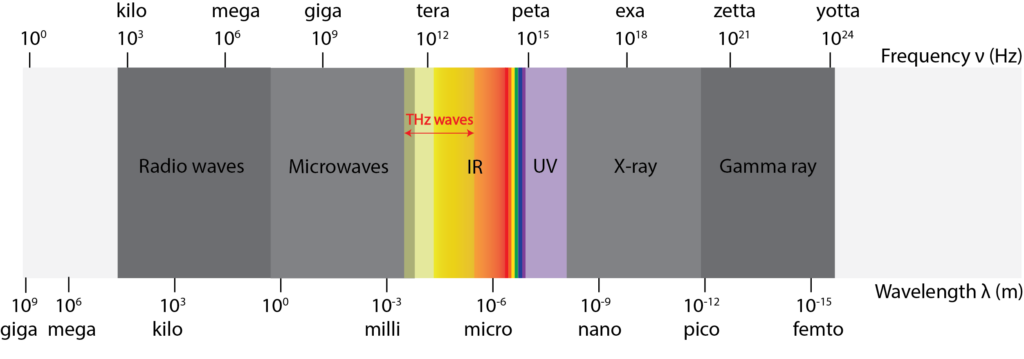
The THz radiation interval is roughly defined to be within 0.1 – 10 THz (0.03 – 3 mm) by the International Telecommunication Union, whereas other definitions also exist depending on different fields of scientific interests. Since the practice of THz research is varied among different scientists in optics, physics, chemistry, and engineering, it is important to address some commonly accepted parameters that are equivalent to 1 THz:
| Value | Equation | |
|---|---|---|
| Frequency | 1 × 10¹² Hz | ν |
| Angular Frequency | 6.28×10¹² rad/s | 2πν |
| Period | 1 ps | 1/ν |
| Photon Energy | 4.14 meV | hν |
| Wave Number | 33.3 cm-1 | 1/λ |
| Temperature | 48 K | hν/kB |
Did You Know?
The first-ever image of a Black Hole captured by the Event Horizon Telescope (EHT) was actually captured in the THz radiation regime.
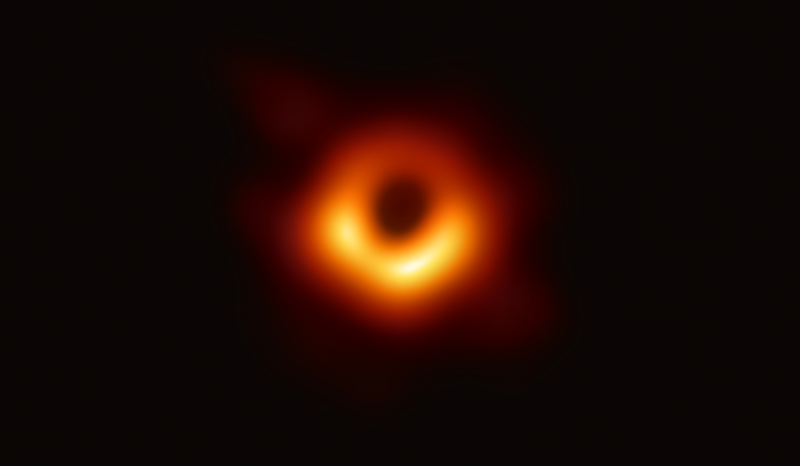
The EHT made this observation at a wavelength of 1.3 mm, which is equivalent to 0.23 THz.
More About Us
Please use the toolbar at the top to learn more about the Zhang Research Lab.